What Is Bergmann's Rule? Full Scientific Explanation with Examples
Bergmann's rule (often searched as bergmans rule or bergmann rule) stands as a pillar of modern ecogeographical study. It dictates the predictable relationship between the body mass of warm-blooded animals and the environmental temperature of their habitat. This principle is not merely a biological observation but a fundamental law of thermodynamics applied to living organisms.
This principle is intrinsically linked to thermoregulation in mammals and forms a triad of rules alongside Allen's and Gloger's rules in biology. Understanding these patterns is essential for anyone studying zoology, ecology, or evolutionary adaptation.
Bergmann's Rule Definition in Biology
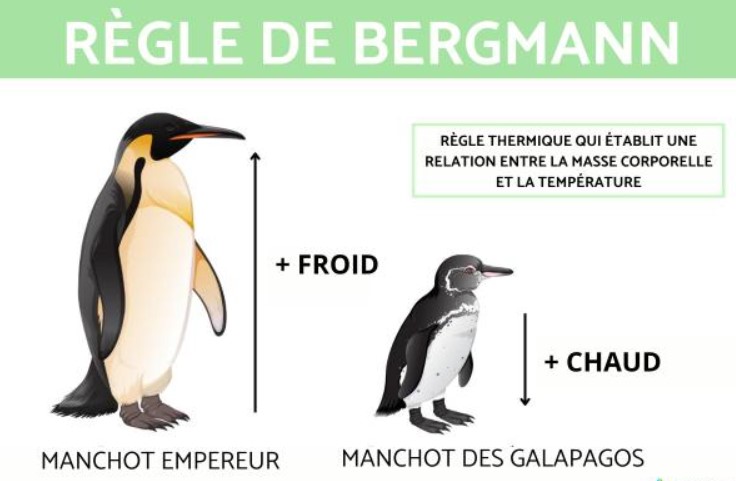
The formal bergmann's rule definition identifies a latitudinal gradient where the body mass of endothermic species (mammals and birds) increases as environmental temperature decreases. This biological pattern suggests that physical size is a direct evolutionary response to environmental stress.
In practical terms, the distribution follows a strict geographic logic:
- High Latitude / Cold Climate: Natural selection favors "Gigantism" or larger body frames to resist freezing temperatures.
- Low Latitude / Warm Climate: Evolution favors "Dwarfism" or smaller, leaner builds to prevent metabolic overheating.
Established in 1847 by the German biologist Carl Bergmann, this rule was one of the first to explain why global biodiversity follows such specific physical trends.
Bergmann's Rule: A Simple Explanation
If you need to understand what is bergmann's rule in simple terms, think about the physics of a large container versus a small one. A massive pot of boiling water stays hot for hours, while a small cup cools down in minutes. This is because the larger volume holds significantly more thermal energy.
In the animal kingdom, a larger body acts as a reservoir of heat. Small animals have a high surface area relative to their small volume, meaning they leak heat like a drafty house. Large animals, like whales or polar bears, have a massive volume relative to their skin surface, acting like a well-insulated fortress against the cold.
The Scientific Mechanism: SA:V Ratio

The bergmann rule explanation rests on the Surface Area to Volume Ratio (SA:V). This is a mathematical certainty: according to the square-cube law, as an animal grows, its volume increases by the cube ($r^3$), while its surface area only increases by the square ($r^2$).
This means a larger animal has less skin surface per unit of body mass. Since heat is lost through the skin but produced in the muscles and organs (volume), being large is a major advantage in the Arctic. Conversely, in a tropical jungle, a large body would produce too much internal heat that couldn't escape fast enough, leading to heat stroke.
Bergmann's Rule Examples in Mammals
Polar Bears vs. Tropical Bears
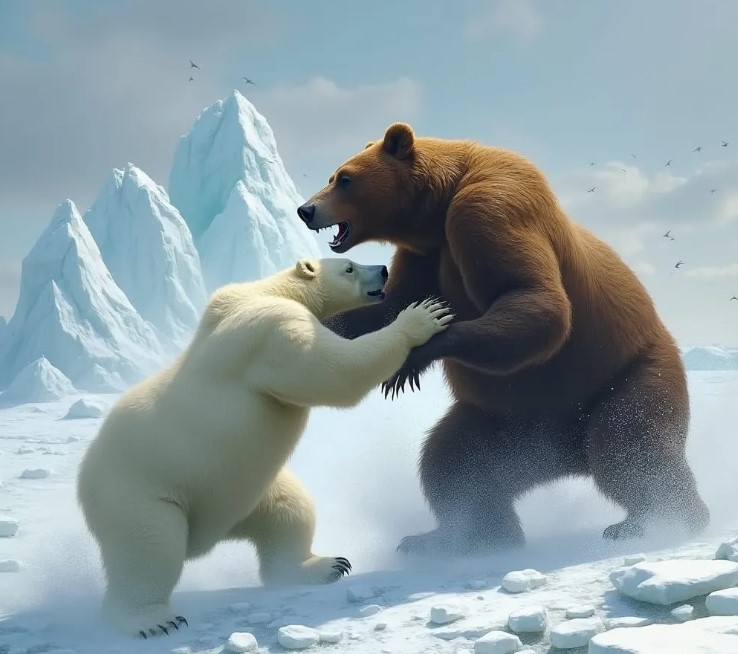
The Polar Bear (Ursus maritimus) is the most iconic example. Evolved for the high Arctic, it is the largest land carnivore. Compare this to the Sun Bear of Southeast Asia, which lives in constant tropical heat and is roughly 10-12 times smaller in mass.
Wolves and Deer
Gray wolves (Canis lupus) exhibit a perfect latitudinal gradient. Alaskan wolves can weigh over 70 kg, while Arabian wolves in the desert often weigh less than 20 kg. Similarly, White-tailed deer in Canada are nearly double the size of their counterparts in Florida.
Bergmann's Rule Examples in Birds

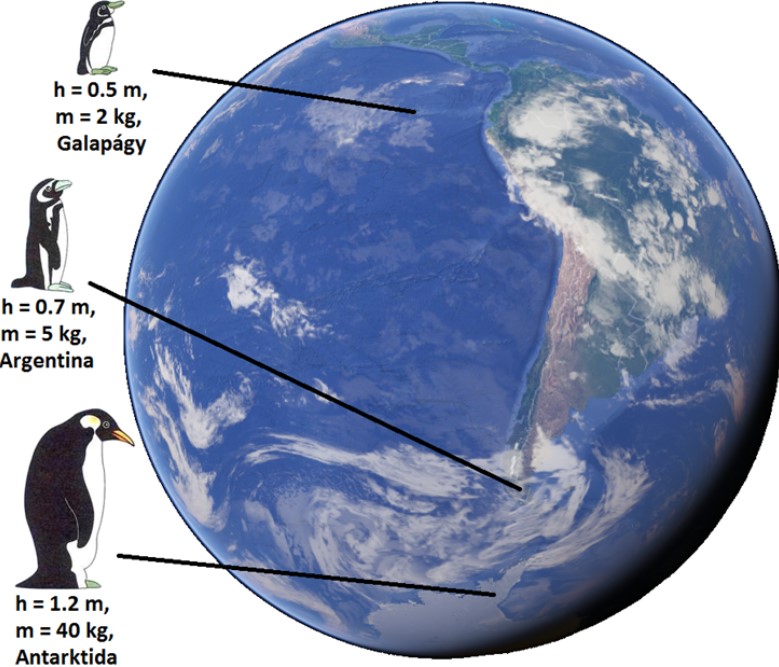
Birds are high-metabolism endotherms, making them even more sensitive to heat loss. Penguins serve as the textbook model: the 120cm tall Emperor Penguin lives on the ice of Antarctica, while the tiny 40cm Galapagos Penguin thrives in the equatorial heat.
Recent studies on House Sparrows introduced to North America showed that northern populations evolved significantly larger body sizes in less than a century, proving how fast this rule acts in nature.
Human Populations & Bergmann's Rule

Anthropologists have long debated the rule's application to humans. While culture and technology buffer us, physical traits still follow the pattern. Indigenous groups in the Arctic (Inuit, Sami) often have stockier, broader builds with shorter limbs—a shape optimized for retaining heat. In contrast, Nilotic peoples of East Africa often possess tall, slender frames with long limbs, maximizing surface area for cooling in the savanna heat.
Bergmann's Rule vs. Allen's Rule: Detailed Comparison
To fully grasp ecogeographical adaptations, one must compare Bergmann's Rule with Allen's Rule. They work together to minimize or maximize heat loss based on the environment.
| Feature | Bergmann's Rule | Allen's Rule |
|---|---|---|
| Biological Focus | Core Body Mass & Overall Size | Length of Limbs, Ears, and Tail |
| Main Strategy | Maximizing heat production/retention | Managing heat dissipation through surface |
| Cold Adaptation | Large, "thick" and heavy bodies | Short, compact ears and short legs |
| Heat Adaptation | Small, light and slender bodies | Long ears, tails, and extended limbs |
News: Global Warming is Shrinking Species
A modern twist on this rule is the "downsizing" of animals due to rising global temperatures. Biogeographic Downsizing is now a major headline in biological news. Research indicates that as the planet warms, the advantage of having a large body in temperate zones is vanishing. Many migratory birds and mammals are evolving smaller sizes in real-time, effectively reversing the Bergmann effect to avoid heat stress in our warming world.
Limitations & Modern Exceptions
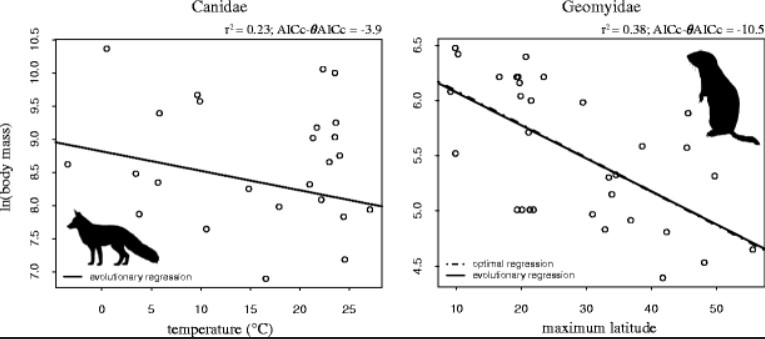
No biological rule is 100% universal. Several factors can override the temperature-size relationship:
- The Converse Rule in Ectotherms: Cold-blooded animals like lizards often grow *smaller* in cold climates because they can't get enough solar energy to sustain a large body.
- Island Dwarfism: On islands, the lack of food is a bigger pressure than temperature. A large animal may shrink to survive on limited resources, regardless of the cold.
- Food Availability: In the deep desert, animals remain small not just because of heat, but because the ecosystem cannot support the caloric needs of a giant.
Frequently Asked Questions (FAQ)
Who discovered Bergmann's Rule?
It was established by German biologist Carl Bergmann in 1847 as a way to explain the relationship between size and climatic temperature in mammals and birds.
Why do large animals stay warmer?
It is due to the Surface Area to Volume ratio. A larger animal has less skin surface area per pound of body mass than a small animal, so it loses internal heat much more slowly.
How does Bergmann's rule affect climate change predictions?
Biologists use the rule to predict that many species will become smaller as global temperatures rise, which could significantly impact food webs and predator-prey dynamics.